Showing posts with label Historical Fiction. Show all posts

Thursday, June 23, 2016

Dad Reviews: America's First Daughter

Today I have a very special guest reviewer - my dad! *high five for family participation* As you guys know, I've been a bit behind lately on reviews as work is infringing on my reading time (boo!), and my dad was nice enough to step up (along with my mom and mother-in-law) to try his hand at reviewing. While I don't think I'll be able to convince him to read and review any YA or adult romance, it's nice to have a little genre variety here on the blog, so thank you Dad for helping me out!

AMERICA'S FIRST DAUGHTER
Stephanie Dray & Laura Kamoie
Historical Fiction
William Morrow
624 pages
Available Now
Source: Bought

THE STORY (from Goodreads)
In a compelling, richly researched novel that draws from thousands of letters and original sources, bestselling authors Stephanie Dray and Laura Kamoie tell the fascinating, untold story of Thomas Jefferson’s eldest daughter, Martha “Patsy” Jefferson Randolph—a woman who kept the secrets of our most enigmatic founding father and shaped an American legacy.

From her earliest days, Patsy Jefferson knows that though her father loves his family dearly, his devotion to his country runs deeper still. As Thomas Jefferson’s oldest daughter, she becomes his helpmate, protector, and constant companion in the wake of her mother’s death, traveling with him when he becomes American minister to France.

It is in Paris, at the glittering court and among the first tumultuous days of revolution, that fifteen-year-old Patsy learns about her father’s troubling liaison with Sally Hemings, a slave girl her own age. Meanwhile, Patsy has fallen in love—with her father’s protégé William Short, a staunch abolitionist and ambitious diplomat. Torn between love, principles, and the bonds of family, Patsy questions whether she can choose a life as William’s wife and still be a devoted daughter.

Her choice will follow her in the years to come, to Virginia farmland, Monticello, and even the White House. And as scandal, tragedy, and poverty threaten her family, Patsy must decide how much she will sacrifice to protect her father's reputation, in the process defining not just his political legacy, but that of the nation he founded.


DAD'S THOUGHTS
When reading this book, one has to remember that this is not a history book. It’s a novel. So it’s much more interesting to read because the characters come to life through dialog that is “creative license.”  But it is strongly based on history, and in fact, each chapter does open with a written record of something from Tom himself. (If you read this book, you can call him Tom. After 624 pages, you should be on a first name basis with anybody.)
 

So you won’t learn a lot that’s new to you about Tom himself unless you are really unfamiliar with him to begin with. You DO come to appreciate what a struggle it was to start up a country: the risks the founding fathers took with their lives, the relationships they had with each other – who they liked, who they didn’t – and the work it took to bring it all together even after the war was done.
 

But mostly, you gain real insight into how incredibly difficult it was to live 200 years ago in a society that ranged from moneyed plantation owners to regular farmers and tradesmen to slaves. Added to that mix are the views of men toward women and vice versa in a land where life was fragile and dangerous, and you and your family’s very survival depended upon each other. It was a complicated culture whose vestiges are still with us today even though we have shed many of the discomforts, dangers and distasteful doctrines of that time. 
 

It’s a heavy topic and a long read, but you come to know the characters quite well and wish the best for their future, even though you know how it ends. Because hey, It’s based on history. But served up much better than you remember in high school.

Find Stephanie:


Find Laura:

Tuesday, September 1, 2015

Cathy Reviews: Sisters of Treason

SISTERS OF TREASON
The Tudor Trilogy #2
Elizabeth Fremantle
Historical Fiction
448 pages
Simon & Schuster
Available Now
Source: Finished copy from publisher for review

THE STORY (from Goodreads)
Early in Mary Tudor’s turbulent reign, Lady Catherine and Lady Mary Grey are reeling after the brutal execution of their elder seventeen-year-old sister, Lady Jane Grey, and the succession is by no means stable.

Neither sister is well suited to a dangerous life at court. Flirtatious Lady Catherine, thought to be the true heir, cannot control her compulsion to love and be loved. Her sister, clever Lady Mary, has a crooked spine and a tiny stature in an age when physical perfection equates to goodness -- and both girls have inherited the Tudor blood that is more curse than blessing. For either girl to marry without royal permission would be a potentially fatal political act. It is the royal portrait painter, Levina Teerlinc, who helps the girls survive these troubled times. She becomes their mentor and confidante.

But when the Queen’s sister, the hot-headed Elizabeth, inherits the crown, life at court becomes increasingly treacherous for the surviving Grey sisters. Ultimately each young woman must decide how far she will go to defy her Queen, risk her life, and find the safety and love she longs for.


CATHY'S THOUGHTS 
I have always had an interest in the stories and lives of those that lived in the era of Henry VIII. So when Jenny asked me to read Sisters of Treason, I gladly accepted. Who doesn't love all that intrigue, plotting and the many beheadings! All the wickedness that surrounds being heir to the throne. The story begins with the beheading of Lady Jane Grey. She was one of the successors of Henry VIII but was quickly overthrown. We are shown the complicated court life of Mary Tudor and Elizabeth I through three different viewpoints. Two are the sisters of Jane Grey: Katherine, young, beautiful and a successor to the throne; and Mary, the youngest sister who suffers from some physical deformities. The third person is Levina, the royal portrait painter. Her observations are appreciated because using her focused painters eye, she sees the court from a removed and non-threatening viewpoint. She tries to protect the Grey sisters by working behind the scenes.
 

Katherine, because of her beauty and position, tends to go through her life with blinders on. She is at the center of the intrigue and her life is constantly in peril but she tends to romanticize what's going on around her. As a counterpoint, we have Mary's thoughts. I enjoyed Mary, even though she's entrenched in the middle of all the drama, her physique allows her to be slightly removed and therefore grasp of the dangers that surrounded she and her sister. These were treacherous and convoluted times. No one speaks the truth and everyone is out to improve their standing in the court, no matter who has to die! What is even more mind boggling is that these girls were hardly more than children when they were being pledged for marriage and becoming involved in plots to overthrow the throne. It is no wonder that if you made it to the age of 40, you were considered old.
 

Ms. Fremantle's historical research is very well done and her descriptive writing plants us firmly into the Tudor court. We become involved in the lives of Katherine and Mary and feel their anxiety about the times in which they lived. As with many historical fiction novels, there is a lot of narrative so that the reader can become engaged in the times but this does tend to slow the pace of the story. Ms. Fremantle does include a family tree and as well as a cast of characters, which are very helpful in keeping the relationships straight. If you enjoy historical fiction, you will enjoy getting to know the Grey sisters, as I did.

Rating: 4/5
 

Find Elizabeth:

This book was sent to me by the publisher free of charge for the purpose of a review
I received no other compensation and the above is Cathy's honest opinion.

Thursday, November 6, 2014

Cathy Reviews: Lies We Tell Ourselves + A Barricade in Hell

I'm pleased today to turn the blog over once again to my mother in law, Cathy, who is one of my bookish partners in crime and so nice as to help me out with reviews on occasion!

LIES WE TELL OURSELVES
Robin Talley
Young Adult/Historical
384 pages
HarlequinTEEN
Available Now
Source: ARC from publisher for review

THE STORY (from Goodreads)
In 1959 Virginia, the lives of two girls on opposite sides of the battle for civil rights will be changed forever.

Sarah Dunbar is one of the first black students to attend the previously all-white Jefferson High School. An honors student at her old school, she is put into remedial classes, spit on and tormented daily.

Linda Hairston is the daughter of one of the town's most vocal opponents of school integration. She has been taught all her life that the races should be kept "separate but equal."

Forced to work together on a school project, Sarah and Linda must confront harsh truths about race, power and how they really feel about one another.

Boldly realistic and emotionally compelling, Lies We Tell Ourselves is a brave and stunning novel about finding truth amid the lies, and finding your voice even when others are determined to silence it.


CATHY'S THOUGHTS
The Lies We Tell Ourselves by Robin Talley is an historical fiction set in 1959. This was a time in our history where segregation was the norm. It was a time of ignorance and fear. Robin Talley captures these emotions with such accuracy that you feel the angst and anxiousness of the characters. She has done her research well and is able to instill these feelings and perceptions in story form and not in a preachy or textbook manner.

There are two main characters: Sarah, a high school senior that is one of several black students to integrate an all white high school, and Linda, a white senior whose father runs the town newspaper and has backward ideas about the differences between races. Before we truly get involved in the story of these two characters, Ms. Talley's opening chapters provide in-depth descriptions of the abuse and humiliation that the black students endure so that they can receive a better education. These chapters are so well written that our emotions rise to the surface, forced as we are to face a bigoted past as well as a barrage negative feelings concerning racial barriers.

Sarah and Linda are assigned to work on a project together. Though this does end up with both of them seeing life and each other differently, it is not written in an overly simplistic format. It is developed over time and with many rocky and violent moments that remind us that life is often neither simple nor easy. There is a twist that gradually becomes entwined in the story–a budding romance. The girls not only have to fight against racial barriers, but also against their developing sexuality.

We always hear that the past was such a simple time, well, this story shows another side, a side we should be aware of and understand. Ms. Talley has told a heart-wrenching tale that brightens with time. It is a story of strength, determination and change. It is well worth reading this story.

Rating: 4.5/5

Find Robin:


A BARRICADE IN HELL
Delia Martin #2
Jaime Lee Moyer
Paranormal Mystery/Historical
331 pages
Tor Books
Available Now
Source: Finished copy from publisher for review

THE STORY (from Goodreads)
Delia Martin has been gifted (or some would say cursed) with the ability to peer across to the other side. Since childhood, her constant companions have been ghosts. She used her powers and the help of those ghosts to defeat a twisted serial killer terrorizing her beloved San Francisco. Now it's 1917—the threshold of a modern age—and Delia lives a peaceful life with Police Captain Gabe Ryan.

That peace shatters when a strange young girl starts haunting their lives and threatens Gabe. Delia tries to discover what this ghost wants as she becomes entangled in the mystery surrounding a charismatic evangelist who preaches pacifism and an end to war. But as young people begin to disappear, and audiences display a loyalty and fervor not attributable to simple persuasion, that message of peace reveals a hidden dark side.

As Delia discovers the truth, she faces a choice—take a terrible risk to save her city, or chance losing everything?


CATHY'S THOUGHTS
I wrote a review for Delia's Shadow and when I finished that book, I hoped there would be a sequel. I so enjoyed the historical setting of 1900's San Francisco and the fact that the story was a mix of genres I love: Romance, mystery, and paranormal. So my wish came true, and Jaime Lee Moyer wrote a follow up story. YEA.

In A Barricade in Hell, we find that Delia and Gabe have been married for a couple of years. Gabe is still the police captain and Delia has been learning to hone her abilities at helping ghosts move on. Ms. Moyer has a knack for merging plot lines beautifully. Gabe is tracking a serial killer and Delia is haunted by a young girl. As the plot thickens, both of them come to the conclusion that a traveling evangelist seems to be at the center of the chaos. They need to join forces to find out what evil is surrounding the city and making people disappear. I love a good mystery and Ms. Moyer knows how to give us only enough information to keep us turning the pages in search of answers.

Yes, there are ghosts in these stories, but they are such a part of the fabric of the story that they're not over the top. If you're unsure about ghosts, you will likely still identify with Gabe who believes in solid police work to solve the crime, but he also realizes that there might just be something else out there given Delia's ability. Even though this is the second in a series, it is a stand alone story. I would recommend reading the first though because the characters are so endearing and the book is such a fun read. As you might guess, I am hoping that I will be able to write a review for a third in the series in the near future.

Rating: 4/5

Find Jaime Lee:

These books were sent to me by the publisher free of charge for the purpose of a review
I received no other compensation and the above is my (or in this case, Cathy's) honest opinion.

Thursday, February 6, 2014

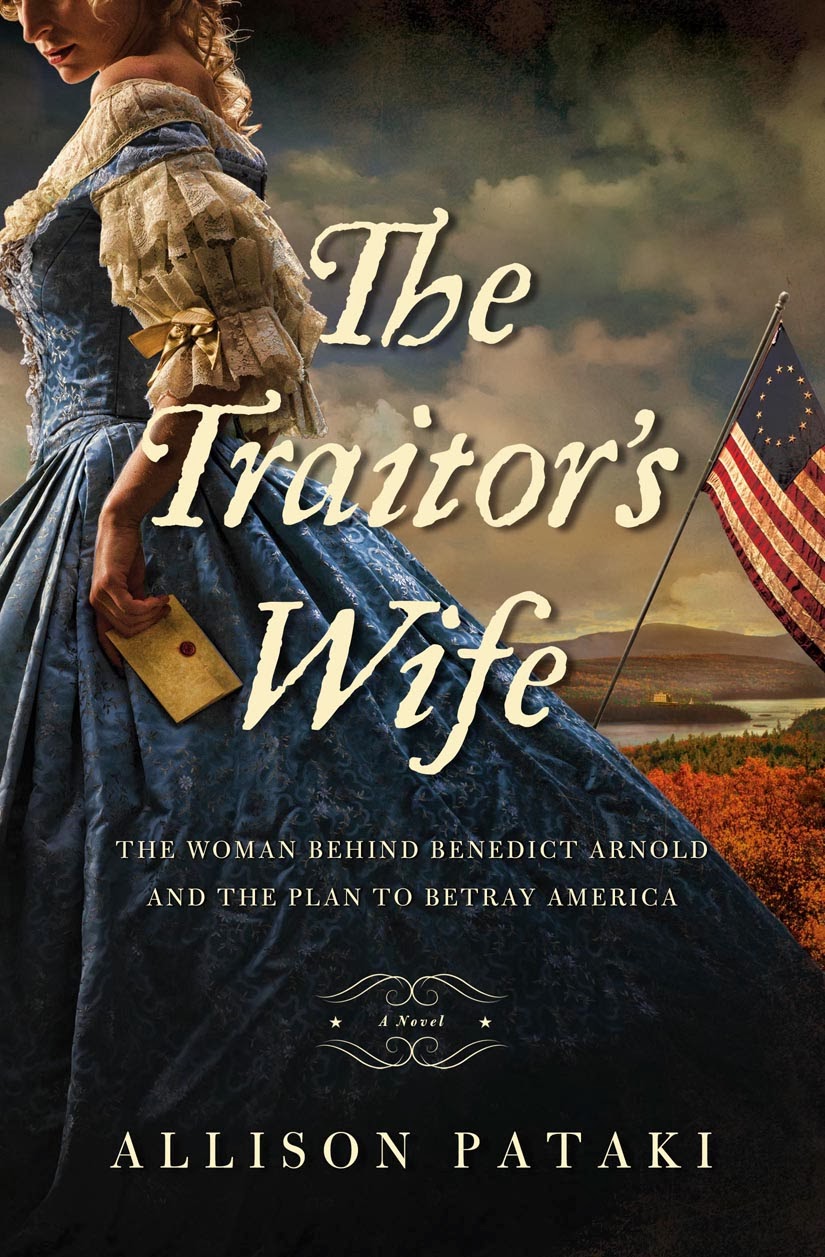
The Traitor's Wife Blog Tour: Guest Post + Giveaway

http://www.kismetbt.com/upcoming-tour/the-traitors-wife-by-allison-pataki

Today I'm pleased to welcome author Allison Pataki to the blog to give us a closer look at one of history's most famous traitors, Benedict Arnold, as part of the promotional tour for her new release, The Traitor's Wife. She's also generously offering up a Kindle Paperwhite, so be sure and check the bottom of the post for all the giveaway details as well as the full list of participating blogs. Welcome to Supernatural Snark Allison!

CHARACTER PORTRAIT
Who was Benedict Arnold and how did he turn from ardent patriot
to shamed traitor?

There’s so much more to the life of Benedict Arnold than just the fateful decision he made to betray the American Revolution. I hope that readers of The Traitor’s Wife will come away from the book with a deeper understanding of who this infamous man was, and how myriad factors – including his marriage, his military career, and his personal demons – helped mold him into history’s most notorious turncoat.

Benedict Arnold’s story began in the colony of Connecticut, where he was a successful businessman and one of the earliest and most outspoken patriots advocating separation from the British. In 1775, Arnold led a force to capture Fort Ticonderoga and its supply of British cannons in what marks the first outright victory of the American Revolution. But even as early as that, though Arnold’s military prowess and courage were applauded, he became embroiled in internecine rivalries and feuds.

Though both Benedict Arnold and Ethan Allen had led the joint mission to Fort Ticonderoga, Ethan Allen and his beloved Green Mountain Boys received the credit. Some of Allen’s men, drunk after the victory, reportedly held a pistol to Arnold’s chest when Arnold demanded that they stop looting and drinking.

During the Battle of Quebec, when Arnold was first shot in the left leg, he held out with just his rag-tag team of men for the winter of 1775-76. It was a punishing mission, during which the men faced below freezing temperatures and the threat of starvation. Arnold paid and fed his men with his own fortune throughout the siege, writing on multiple occasions that he was fully prepared to die for the Revolution.

Arnold fought on Lake Champlain, preventing a British naval invasion, while his colleagues were in Philadelphia during the summer of 1776, signing their names to the immortal Declaration of Independence. Arnold fought the British alone in Norwalk, Connecticut, where his horse was shot out from under him.

The one battle where Arnold finally earned the recognition that was his due was the Battle of Saratoga, the undisputed turning point of the war. Arnold’s tactical genius allowed the Continental Army to repel the British attack. Then, defying the orders of his commander, Arnold led the crushing counterattack to defeat the British. It was during this battle that Arnold was shot a second time in his left leg.

In spite of his skill in battle, Arnold seemed to have no skill in making friends. He was passed over for promotions constantly; he was never reimbursed by the Continental Congress for the thousands of dollars he had spent; and he was never again able to walk without pain. He saw himself constantly belittled by his colleagues. Throughout the early years of war, though the American people adored him, it seemed that Arnold’s only ally in the army was General George Washington.

It was after all of these battles and feuds had occurred that Arnold assumed his role as military commander in Philadelphia. In that city, Arnold used his position of power to sell the confiscated goods from Philadelphia shops and merchants on the black market. This earned him a court martial, a censure from his former champion, George Washington, and more bad press.

By this time, Arnold felt embittered by the numerous slights and attacks being leveled by his own side. He was in pain and facing near financial ruin. And, he happened to have a beautiful new wife. Peggy Shippen Arnold was a Philadelphia belle half his age. A clever and charming young woman who happened to favor the British cause. When Peggy suggested that her beleaguered husband write to a “friend” of hers, a British spy by the name of Major John André, Arnold agreed. It was that correspondence that ultimately led to Arnold’s decision to betray the American cause and defect to the British.

It’s interesting to mull these circumstances over and ask how it might have gone differently for the fallen patriot. Was Arnold treated unfairly by his side, causing him to become irretrievably bitter? Or was Arnold a difficult personality who invited this enmity? Was he a man who could negotiate the dangers of a battlefield but had no ability to navigate human relationships? Did Peggy have the deciding influence in her husband’s decision, or had he already soured on the cause that had once been his life’s purpose? We can never truly know. But, unfortunately for Arnold, he got one big decision wrong. And that decision, to turn to the British, is how history remembers him.

• • • • • • • • • • •

THE TRAITOR'S WIFE


A riveting historical novel about Peggy Shippen Arnold, the cunning wife of Benedict Arnold and mastermind behind America’s most infamous act of treason.

Everyone knows Benedict Arnold—the infamous Revolutionary War General who betrayed America and fled to the British as history’s most notorious turncoat. Many know Arnold’s co-conspirator, Major John André, who was apprehended with Arnold’s documents in his boots and hanged at the orders of General George Washington. But few know of the integral third character in the plot; a charming and cunning young woman, who not only contributed to the betrayal but orchestrated it.

Socialite Peggy Shippen is half Benedict Arnold’s age when she seduces the war hero during his stint as Military Commander of Philadelphia. Blinded by his young bride’s beauty and wit, Arnold does not realize that she harbors a secret: loyalty to the British. Nor does he know that she hides a past romance with the handsome British spy John André. Peggy watches as her husband, crippled from battle wounds and in debt from years of service to the colonies, grows ever more disillusioned with his hero, Washington, and the American cause. Together with her former lover and her disaffected husband, Peggy hatches the plot to deliver West Point to the British and, in exchange, win fame and fortune for herself and Arnold.

Told from the perspective of Peggy’s maid, whose faith in the new nation inspires her to intervene in her mistress’s affairs even when it could cost her everything, The Traitor’s Wife brings these infamous figures to life, illuminating the sordid details and the love triangle that nearly destroyed the American fight for freedom.


 • • • • • • • • • • • 

ALLISON PATAKI


ALLISON PATAKI grew up in upstate New York, in the same neighborhood where Benedict and Peggy Arnold once lived. Allison attended Yale University, where she graduated Cum Laude with a Bachelor's Degree in English. While at Yale, Allison received Distinction in the Major from the English department and served as a campus reporter and news anchor for the student-run campus television program, YTV News.

The daughter of former New York State Governor George E. Pataki, Allison was inspired to write The Traitor’s Wife: A Novel of Benedict Arnold and the Plan to Betray America based on the rich Revolutionary War history of her hometown in New York State’s Hudson Highlands.

Allison spent several years writing for television and digital news outlets prior to transitioning to fiction. The Traitor’s Wife: A Novel of Benedict Arnold and the Plan to Betray America is Allison’s first novel.

Allison lives in Chicago with her husband.


• • • • • • • • • • •

GIVEAWAY
Be sure and check out all the tour stops for more guest posts, interviews, and chances to win!


Tuesday, December 18, 2012

Guest Post: James Lyon + Kiss of the Butterfly


Today I'm excited to share the blog with author James Lyon so he can tell us a little bit about his novel Kiss of the Butterfly and the vampire mythology found in it. I should mention that it's possible he regrets shooting me his initial email as it led to the creation of a guest post topic I'm sure he never expected to actually have to write about. I find this highly amusing :-) I have to applaud James for being a good sport and tackling his topic with enthusiasm, and I hope you all enjoy the result!


VAMPIRES: TAP DANCING OR GANGNAM STYLE?

Have you ever said something kinda dumb, and then afterwards kicked yourself in the seat of the pants and asked: “why on earth did I say that?” Well, when Jenny and I were corresponding about this post and my new book Kiss of the Butterfly, I did exactly that. Below is the email exchange that took place:

Jenny: “I read in your previous email that this book deviates from popular vampire legend, and one thing I love about vampire stories is how authors create their own mythology, so maybe something along those lines?”
 

James: “Your comments about each author constructing his/her own vampire is spot-on… I based all my descriptions of vampires on local Balkan folklore, which gives an altogether different vampire than many are accustomed to… since they don't sparkle, I'll have to teach them to tap-dance or something else.” :-))
 

Jenny: “Hahaha tap-dancing vampires sound brilliant, can't wait” ;-)

Oh boy. Me and my big mouth. Since I personally know of no tap-dancing vampires, I had to find one. Well, I began the hunt, high and low, far and wide, near and far, Google, Yahoo, Bing, Safari, Chrome, everything!! The pickings were slim.

Buffy the Vampire-Slayer had a demon named Sweet, who tap-danced, but he wasn’t a vampire. The cast of Twilight took tap-dancing lessons prior to shooting the sequel New Moon, but can anyone recall tap-dancing scenes in it? A Goth girl posted a video of herself tap-dancing in the driveway in front of her house in full sunlight on youtube, dressed in her interpretation of a vampire, forgetting that daylight might be unhealthy for the undead. And a High School student posted a sketch of tap-dancing vampires she drew in art class, but never finished, because she spilled nail polish on it. And that was it.

No tap-dancing vampires… couldn’t find any. So I thought I’d hold open auditions on Halloween for any trick-or-treaters dressed as vampires, but since I currently live outside the US in a country where they don’t have Halloween, there were no trick-or-treaters. Instead, all the Catholics celebrated All Saints Eve by going to the graveyards in the evening and lighting candles, while the Orthodox Christians and Muslims didn’t celebrate it at all. All those lit-up graveyards made for a spooky sight, but didn’t help me in my quest for the elusive tap-dancing vampire.

And then I figured out why there are no tap-dancing vampires. You’ll find my answer at the end of this post.

But first, let me share with some tidbits about the vampires in my universe. Vampire legends originated in the Balkans over a thousand years ago, and there are written records of them dating back to as far as 1347. Even today many people believe they exist. Just this year, a man was arrested in Serbia for digging up a neighbor’s coffin and driving a stake through his heart, because he was convinced his neighbor had become a vampire and was haunting the village.

So I decided to go back to the roots of the vampire legend and write about the creatures that existed in the millennia-old folk tales from Montenegro, Serbia, Bosnia, Croatia, and Macedonia. This meant I read lots of dusty old books in exotic languages, and spoke with people in small villages and observed them practice customs designed to ward off vampires. And the vampires I discovered
were altogether different from today’s pop culture vampires, and bore only a faint resemblance to Bram Stoker’s Dracula.

I discovered why they place coins on the eyes of a dead person, why you shouldn’t hang around watermills after dark, why you must not let an animal pass over or under the body of a dead person awaiting burial, why a simple stake isn’t enough, why butterflies cluster on Hawthorn trees and freshly dug graves, and why your new neighbor might not be who you think he is, especially if he is a butcher, cutlery or cookware salesman. I also gained an appreciation for the taste of garlic, and am waiting for the genius to be born who will invent garlic-flavored chocolate bars.

Spoiler alert for Twilight fans: in Kiss of the Butterfly and Balkan folklore, a conflict between vampires and werewolves is impossible.

Now that you’ve come this far, are you ready for my solution as to why there are no tap-dancing vampires?

Well, of course, they’ve all switched to Gangnam Style!!!

A huge thank you to James for making the most of the hand I dealt him and for his extensive search for the legendary tap-dancing vampire;-) More information on James and his books can be found here:

Facebook
Twitter
Goodreads
Amazon Buy Link
Amazon UK Buy Link

KISS OF THE BUTTERFLY

"I sense it even now. People thirst for it; the entire country is mad with desire for it. And now we are going to war with our brothers because they look like us, and because we can smell our blood coursing through their veins...” 

A dying man’s cryptic letter to an enigmatic professor launches grad student Steven Roberts on an unwitting quest, shrouded in mystery, into the war-torn labyrinth of a disintegrating Eastern European country. Steven plunges into the maelstrom to unearth long-forgotten documents holding clues to an ancient Emperor’s deeply buried secret, an inconceivable and long-forgotten evil that has slumbered for centuries. Steven’s perilous journey stretches from Southern California’s sunny beaches, to the exotically dystopian city-scapes of Budapest, Belgrade, and Bosnia, as it plays out against a backdrop of events that occurred centuries before in the Balkans.

Meticulously researched and set against the background of collapsing Yugoslavia, “Kiss of the Butterfly” weaves Balkan folklore together with intricate historical threads from the 15th, 18th and 20th centuries to create a rich phantasmagorical tapestry of allegory and reality. It is about passion and betrayal, obsession and desire, the thirst for life and the hunger for death. And vampires – which have formed an integral part of Balkan folklore for over a thousand years – are portrayed in their original folkloric form, which differs dramatically from today’s pop culture creations.

“Kiss of the Butterfly” is based on true historical events. In the year of his death, 1476, the Prince of Wallachia -- Vlad III (Dracula) -- committed atrocities under the cloak of medieval Bosnia’s forested mountains, culminating in a bloody massacre in the mining town of Srebrenica. A little over 500 years later, in July 1995, history repeated itself in Srebrenica, when nearly 8,000 people were killed, making it the worst massacre Europe had seen since the Second World War. For most people, the two events seemed unconnected... 

Friday, November 30, 2012

Review: Gilt

GILT
Katherine Longshore
Young Adult/Historical
406 pages
Viking Juvenile
Available now
Borrowed from Karen at For What It's Worth

THE STORY (from Goodreads)
In the court of King Henry VIII, nothing is free--
and love comes at the highest price of all.


When Kitty Tylney's best friend, Catherine Howard, worms her way into King Henry VIII's heart and brings Kitty to court, she's thrust into a world filled with fabulous gowns, sparkling jewels, and elegant parties. No longer stuck in Cat's shadow, Kitty's now caught between two men–the object of her affection and the object of her desire. But court is also full of secrets, lies, and sordid affairs, and as Kitty witnesses Cat's meteoric rise and fall as queen, she must figure out how to keep being a good friend when the price of telling the truth could literally be her head.


MY THOUGHTS
Gilt is not one of those novels where the pages practically turn themselves, our intense desire to reach the end physically expressed through the rapid devouring of chapters; instead we carry a burden from the very beginning, our preexisting knowledge of Catherine Howard’s fate slowing our progression to an almost crawl as we dread the flip of the page for how much closer it brings us to her brutal demise. Because the pace is a bit slow—Kitty’s arrival in the queen’s court not even taking place until almost a third of the way through—it takes our interest and curiosity a bit longer to be piqued, our attention waxing and waning repeatedly as sumptuous details of fabric, jewelry, and other various descriptions weigh us down before the intrigue, betrayal, and sinister nature of the Tudor Court grabs our focus back and holds it unwavering.

Kitty is a beautifully depicted character, loyal to a fault to those who don’t always deserve such unwavering devotion, and someone who grows from a timid girl scared to share her opinion to a surprisingly strong young woman who finds her voice even though it often falls of deaf ears. Her confusion and hesitancy when she’s thrust into life at court settles heavily in our guts as soon as she sets foot there, our instincts crying out at us to shield her from Cat’s manipulations as we know they are only going to grow more devious and have far more dire consequences the more time she spends in the queen’s employ. Though it takes her a while, Kitty finally learns to stand her ground, years of daily lessons on how to recognize the cruel twist of lips hidden behind beatific smiles and how to see ugliness hidden beneath the shine of wealth and privilege ensuring she cuts her strings for good, free of the puppeteers with whom she’s spent her entire life.

Cat is both terrible and benevolent, her selfishness unparalleled and often appalling, but there are rare moments when her love for Kitty seems to be genuine, giving us a brief glimpse at the toll life as queen takes on her. Those moments are few and far between however, and we spend a great deal of time wanting to scream at the top of our lungs, hoping our voices will breach the fictional barrier and make her see that the bed she’s making for herself will soon be stained with the blood of those whose lives she so callously plays with day in and day out. She thinks only of herself up until the very moment she presents her neck for the executioner’s axe, and we can do nothing but shake our heads in dismay that she didn’t open her eyes and learn from the mistakes made by the women married to Henry before her, instead allowing her youthful sense of invincibility to obscure what history was so clearly trying to show her.
 

Overall, Gilt is a fascinating read for no other reason than the glimpse of Tudor history it gives us, though we easily close the back cover thankful to be in our reality with our heads blissfully attached to our bodies. Those who adore historical fiction for the atmosphere and the minute, intimate details of day-to-day life will revel in the pictures Ms. Longshore beautifully paints, though those readers who have a more superficial appreciation for it may at times begin to feel the full length of the 400 pages and wish Cat’s rise and fall as Queen Catherine might have been depicted at a quicker pace.

Rating: 3.5/5