
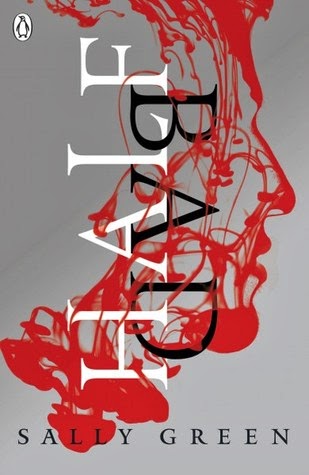
Half Life #1
Sally Green
Paranormal Young Adult
416 pages
Viking Juvenile
Available Now
Source: Finished copy from publisher for review
THE STORY (from Amazon)
In modern-day England, witches live alongside humans: White witches, who are good; Black witches, who are evil; and sixteen-year-old Nathan, who is both. Nathan’s father is the world’s most powerful and cruel Black witch, and his mother is dead. He is hunted from all sides. Trapped in a cage, beaten and handcuffed, Nathan must escape before his seventeenth birthday, at which point he will receive three gifts from his father and come into his own as a witch—or else he will die. But how can Nathan find his father when his every action is tracked, when there is no one safe to trust—not even family, not even the girl he loves?
MY THOUGHTS
Half Bad is one of those stories we enter into with a certain set of expectations based on the limited amount of information provided by the synopsis, but, as is sometimes the case, once we crack the spine we find a very different type of novel than we'd anticipated. It’s not the story’s fault we'd prepared ourselves for an entirely different direction than it ended up taking, but it does take us a bit of time to reconcile where we thought we would be headed with where Nathan’s journey actually takes us. A story about witches has visions of magic–light and dark–dancing in our heads, and the mention of a girl in the same sentence as the word “love” has the romantic in us rubbing our hands together in glee, but what we find is a tale largely absent both magic and romance, leaving us just a touch off kilter even as we start to fall hard for young Nathan.
The format of Half Bad plays a large role in our initial disconcertion, starting us off in second person for the first couple chapters as we join Nathan in his cage before switching to first person and taking us back in time to when Nathan was just a boy. We follow Nathan from boyhood to age sixteen where we’re reunited with our timeline from the first few chapters, but just as we’re brought back to Nathan’s time in the cage, we’re once again shifted to second person for a chapter or two before returning to first person and staying there for the remainder of the book. The second person perspective doesn’t seem altogether necessary unless it will serve some greater purpose in the coming installments, so the switch back and forth becomes more jarring than it might have been otherwise if we understood the reason for it.
Though the perspective switch is off-putting, Nathan himself is an extraordinarily interesting young man, someone we’re rooting for from the moment we find ourselves locked in that cage with him. He’s treated abominably from a young age for being half Black Witch and half White, but though he suffers gut-wrenching abuse both emotional and physical, he never truly allows himself to be beaten. His fire burns brightly throughout, flaring up when he’s at his most defensive but staying coolly banked the remainder of the time, showing us he knows how to play the game the White Witches force upon him better than they ever dreamed he would. The true highlight of this story is Nathan’s beautiful relationship with his brother Arran, the bond between them both heartwarming and heartbreaking as they find themselves torn apart by the cruelty of those who, to our knowledge, are more monstrous than those from whom they claim to be protecting the world.
Though Nathan is attracted to a White Witch named Annalise before he finds himself imprisoned, there’s no real romance to be had in this story, something that’s not a true complaint as the addition of such would have detracted from the intense loneliness radiating from Nathan. He’s on his own in every way in this story, fighting battles both internal and external, and his nearly total emotional isolation (with the exception of Arran) creates an intriguing intimacy between he and us as readers. We don’t get to learn much about this world or the witchcraft that dominates it–Nathan’s ability to heal almost the only magical aspect throughout–leaving us hoping for both more history and more magical gifts in the next installment. Overall, Half Bad is a slower read than we might expect going in, Nathan’s story more of a straight line than a jagged one with lots of peaks and valleys, but the potential for future greatness is undoubtedly there and is more than enough to have us eager to pick up book two.
Rating: 3.5/5
Find Sally:
This book was sent to me by the publisher free of charge for the purpose of a
review.
I received no other compensation and the above is my honest opinion.


